Showing posts with label young writers. Show all posts

Wednesday, December 24, 2014

So this is Christmas.

So, this is Christmas.  The season of sentimentality.  I’ve been fumbling and stumbling for too long now, day-to-day, under a fog of sadness…exhausted (2014 has been a rough year.)  But then, reading in my favorite chair next to the Christmas tree with Vince Guaraldi on the stereo playing “Christmas Time is Here” (how much more cliché could I get), I felt the welling up, the lump in my throat and the fog began to lift.  I began to jot notes for poems in the back of the book I was reading.  I began to hear words in the music, music in the words. 

A poem begins with a lump in the throat; a homesickness or a love sickness. It is a reaching-out toward expression; an effort to find fulfillment. A complete poem is one where an emotion has found its thought and the thought has found words. – Robert Frost

I say, let the schmaltz run free!  And what better time than at Christmas with so much emotion tied to memories, happiness and sadness, love that is with us and love that is gone.  So many ways to wrench our hearts…to break them wide open.


And I believe for we writers (artists of any ilk actually), we cannot be afraid of the sentimentality within us, cannot be afraid to remember, cannot be afraid to feel.  All of our stories are born out of memory.

There are periods when work stress and the demands of day to day living can numb the poetry out of my brain, can put me into that fog of sadness.  So when pictures of Christmas past or some sappy romantic Christmas movie bring a tear to my eye, I know I can still feel.  And that is the time to write, when the crack has been made in the hard shell of life.  Take advantage of the moment, seize those powerful emotions because even if they were provoked, aroused, teased by romanticism or manipulated by formulaic theatre…those are still real emotions triggered by the part in us that has no connection to rationality.

The skill is in being able to craft and shape away the cliché and the trite.  That is the making of art. Without the emotion there is no art.
Poetry is best when it is something you just gotta get off your chest…I personally only write when I absolutely have to – when it gets so it hurts too much if I don’t. – Kenneth Rexroth
So Merry Christmas, drink it in to the last sweet and sappy drop, and when you can’t take it anymore, write!

I offer you a poem, hope you enjoy it.


My Only Christmas Poem

Here’s to the Christmas tree that fell
breaking our tiny glass heart ornaments
dangerous shiny slivers stuck in the carpet nap,

to the evergreen needles
swept into a pile, to the roasted potatoes
burnt and stuck to the bottom of the pan,

to your father’s last Christmas
when he made shy Courtney sing.
Here’s to the last bottle of wine.

Here’s to blown fuses, to stale cookies,
to all the gifts that were wrong,
to Dexter Gordon’s “Have Yourself a Merry Little Christmas.”

Here’s to Italy’s Seven Fishes
and to a Charlie Brown Christmas tree.
Here’s to Linus and Scrooge.

Here’s to building sailing ships at 2 a.m.
Here’s to the year we almost missed.
Here’s to our 12-year-old son who tells us

dancing in front of the tree
is way too corny.


Saturday, November 1, 2014

A Fly in The Soup, on being a young writer in Chicago

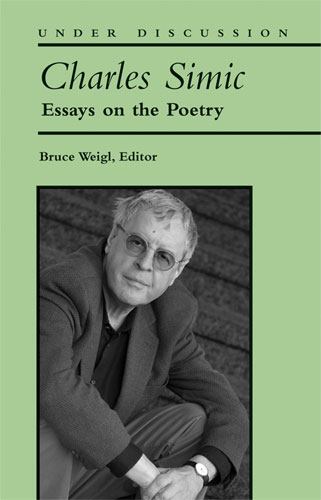
     For the uninitiated, the main entry hall of Oak Park River Forest High School (Oak Park,  a suburb just adjacent to Chicago’s West Side) has a special and proud feature identified by students as the “wall of fame.”  It consists of neat rows of framed pictures of notable graduates of the school.  Some more recognizable than others, some are Hollywood types, others scientists or statesmen, and of course the school’s Nobel Laureate Ernest Hemingway.  (You’d think that with Hem’s literary stature and international fame the school could go a little bigger and with a better quality photo print, but I digress.)  Not very far from the photo of Hemingway is a photo of Charles Simic with the caption “poet.”   Taking a quick poll, I count five of my poet and English-major-type friends who actually know who Simic is.

     Not unlike Hemingway, Charles Simic left Oak Park shortly after graduating from high school.  Also like Hemingway, Simic left Oak Park determined to be a writer.  Also like Hemingway, Simic went on in 1990 to win a Pulitzer Prize for his poetry (having been a runner up in 1986 and 1987).  In 2007, Charles Simic was named the fifteenth Poet Laureate of the United States.   His other awards, including the Wallace Stevens Award, and publications of poetry, non-fiction, and translations are too many to list here (but easily found with an internet search, or at the library).
     And to think it all started at OPRF, in Chicago-land.  Well, almost.  Simic grew up in Belgrade, Serbia (then part of Yugoslavia), during World War II.  As refugees, the family moved to Paris (where Charles began studying English) and eventually to the U.S.  The Simics arrived in Chicago in 1955.  

     In his memoir a fly in the soup, Simic credits teachers at OPRF for encouraging his literary bent and his love for poetry.  During his high school years he began writing poetry in English, as well as becoming a painter.   “My school was no joke,” he writes in his memoir, “One had to study, do homework every night and be prepared to answer intelligently in class.  My classmates were mostly children of professional people and had the confidence and ability of well-brought-up young people…I think I was the only foreigner in the school, and so I was a curiosity.”
     But what is it about Chicago that makes writers?  And “tough” writers at that: Hemingway, Sherwood Anderson, Algren, Sandburg, Dreiser, Richard Wright, Royko, Norbert Blei, even Simic.  Certainly not just a suburban high school.  Maybe it was the midnight el rides coming home from work or college night classes.  Maybe it was the late-50s Chicago literati with whom Simic spent time, as all good 20-year-olds do, drinking, smoking, listening to jazz, and watching sunrises. 
     “In those days,” Simic describes, “much more so than today, radical intellectuals came from working-class backgrounds.  They worked with their hands, or they were union officials. Children of immigrants, they had plenty advice for a newcomer like me…you ought to be writing poems about old Polish ladies who sweep the downtown offices at night.”

     Charles Simic has been called an American poet with a Serbian accent, he describes the “Chicago effect” in a fly in the soup:
Chicago gave a better sense of what America was than some small town or New York would have.  Its mixture of being, at the same time, very modern and very provincial is a national characteristic.  Add to that the realization that so much of our national prosperity depends on cheap labor.  Immigrants and blacks kept Chicago humming. I like the anarchy of the city.  There were dives and strip joints a few blocks from the monumental Art Institute…Chicago was the garage sale of all the contradictions America could contain.  A rusty water tower on the top of an old warehouse would look as beautiful as some architectural wonder along the lakeshore.  Every notion of aesthetics one previously held had to be revised if one were to appreciate the city.  My greatest teachers, in both art and literature, were the streets I roamed. 
So, your Poet-At-Large roams the streets still.  You come too.